Curriculum at a glance
The most up-to-date, effective tech stack on the market:
Push your boundaries. Explore how AI engineering seamlessly combines data science and machine learning to tackle complex web architectures. Master the latest AI technologies with our Data Science and Machine Learning Bootcamp course.


Step beyond your comfort zone and transform from an aspiring AI engineer to an inspiring one. Master data science and machine learning with the most comprehensive curriculum on the market. 🚀
What's in store at our AI engineering bootcamp
Students are introduced to the overall structure and expectations of the course. They learn how to organize their learning, manage time and stress, and develop a mindset that supports professional growth. An initial overview of the IT industry helps them understand their future work environment, while the first steps in career development and personal branding help set long-term goals. A dedicated session on how to responsibly use AI tools prepares students to integrate AI thoughtfully into their learning. Technical setup ensures everyone is ready to get started.
Students will learn the basic set of skills needed to work in a unix shell. They also recap on general programming Python language fundamentals and write and execute their first small programs. By using Git and Github, they are introduced directly to modern collaborative work in the industry, including code versioning, as well as working collaboratively on the codebase with others through the use of concepts such as branching and pull requests.
Building upon the fundamentals of Phase 1, students are introduced to tools for extracting and manipulating data from different sources, like files but also databases. To do this they use SQL and Pandas. After practicing data manipulation skills they dive into creating descriptive analysis using various plotting libraries and plot types. This phase is completed with a 2 days project focussed on Exploratory-Data-Analysis (EDA) where students work on a real-world dataset. Always with the business case in mind, they provide their artificial stakeholder with recommendations and meaningful visualizations tailored to their needs.
This section covers the basic concepts of supervised machine learning techniques like regression and classification. Students are introduced to multiple algorithms among others linear and logistic Regression and Decision Trees. Beside introducing the algorithmic and statistical details of various machine learning algorithms, we have the scope and assumptions of the modes in mind. We emphasize the importance of model evaluation and which tradeoffs one have to have in mind when building predictive models. Students apply all of their learned skills by working in groups on a 4 day machine learning project that covers the whole data science life cycle. Together they set milestones and consider the value of their data product, while gaining experience in collaborative work with Git and Github. The final step is a presentation to the stakeholders.
With a basic understanding of statistical learning techniques and the underlying software implementation, students dive deeper into techniques for forecasting on Time Series. In a world with mostly unlabeled data, it is important to tackle also the challenges of unsupervised learning. Students will get an introduction to both dimensionality reduction and clustering techniques. To get some understanding of concepts that are nowadays often referred to as AI, students get an introduction to artificial neural networks. Building their own deep neural network from scratch will improve their understanding of the underlying processes and concepts. Also typical areas of application like Natural Language Processing and common related techniques like transfer-learning will be addressed.
To condense all the skills learned and also focus even more on group work and collaboration, the capstone project gives the context and time to work on a bigger data science problem from start to end. Students have the chance to find a problem by their own, using publicly available datasets or work with data provided by one of our partner companies. In teams of 3 to 4 people they work towards achieving and presenting a solution to the given problem. Thereby, not only the gained knowledge regarding technical topics and agile methodologies will be applied, but they will also extend their skills based on the requirements of their projects.
Bridge the gap between data science notebooks and production-ready code. Focus on clean code, object-oriented programming (OOP), and testing.
Finalize software foundations with Docker and begin Data Engineering by learning to move and model data reliably.
Master workflow orchestration and understand the difference between batch and real-time data processing.
Transition from modeling to production. Learn behavioral testing and deployment strategies for ML systems.
Automate the delivery of ML software using Docker and Continuous Integration/Continuous Deployment (CI/CD) pipelines.
Ensure production systems stay healthy by monitoring service performance and model degradation.
Simulate a full MLOps cycle and begin the transition into Large Language Model (LLM) Engineering.
Communicate effectively with LLMs and build Retrieval-Augmented Generation (RAG) systems.
Optimize LLM performance using Fine-Tuning (LoRA/QLoRA) and Hybrid RAG architectures.
Build autonomous agents that use tools and reason through complex tasks using standard protocols.
Finalize agentic workflows and learn to serve LLMs as scalable APIs.
Deploy LLM applications to the cloud and implement specialized monitoring for GenAI.
Kick off the final project. Define the problem, set success metrics, and build the data acquisition pipeline.
Transform data into features, train baseline models, and present early results.
Automate the training workflow and finalize the production architecture.
Finalize CI/CD, documentation, and present the complete end-to-end system.
The most up-to-date, effective tech stack on the market:
Learn Python, SQL, and object-oriented programming. Use Pandas and NumPy to manage and analyze data efficiently.
Explore EDA, statistics, and feature engineering. Turn raw data into insights and prepare data for modeling.
Apply regression, classification, decision trees, KNN, ensembles, clustering, and recommender systems to solve problems.
Build neural networks with TensorFlow/Keras. Work with CNNs, transfer learning, and natural language processing with LLMs and AI agents.
Use APIs, web scraping, and Streamlit. Deploy and monitor ML models with Docker, MLOps, MLFlow, and cloud pipelines.
Complete portfolio projects and capstones. Develop teamwork, agile workflows, communication, and data ethics for real-world impact.

What good are skills without getting a foot in the door? We focus extensively on helping you ace real world technical interviews.
We believe that development is continuous, so we offer up-to-date career coaching sessions to help you progress professionally.
Changing careers is more than learning new tech skills. We additionally provide you with spot on soft skills to ace your application process.
Wondering ‘what’s next’? We're connected with exciting startups and companies in Germany.
Spicedlings are getting hired by your favourite companies:
Invest in your future
If you’re registered as unemployed (or soon to be) in Germany, you could be eligible to have all your costs covered with a Bildungsgutschein (training voucher).
For more information on this option, check our page dedicated to financing your coding bootcamp with a Bildungsgutschein.
We want to make our best-in-class tech courses available to everyone with the motivation to complete them.
Our Deferred Payment Option enables those who aren’t in the position to pay upfront nor in instalments to participate, by offering the chance to pay back at a later date.
If you’re ready to cover the cost of our coding bootcamps immediately, this is the option for you. Pay 14 days before the course starts.
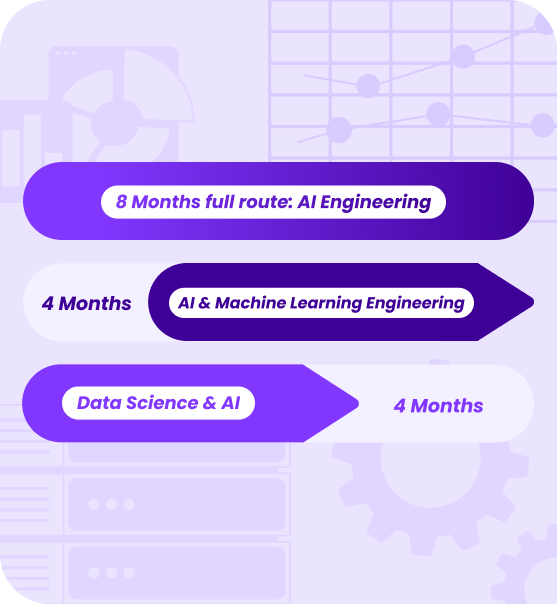
32 Weeks | Full-time
At SPICED Academy, we're dedicated to your success. Throughout the bootcamp, our experienced instructors and mentors will guide you, answer your questions, and provide valuable feedback tailored to advanced programming. Our learning environment encourages independent exploration, ensuring you get the most out of your AI Engineering journey with us.
Our course is designed to take you from an intermediate level to beyond. If you're new Data Science and AI, be sure to check out our Data Science & AI program.
SPICED stands out by focusing on hands-on experience and preparing you for real-world AI engineering scenarios. Our supportive community creates an environment where you can excel and thrive as a developer. We emphasize practical skills and industry relevance, equipping you with the necessary tools for success in programming beyond the classroom.
In Germany, AI engineer salaries vary based on factors such as location, experience, and skill level. On average, experienced professionals can command salaries ranging from €60,000 to €80,000 per year.
Excellent local perspective—Berlin leads in AI startups and scaleups. Entry-level roles and earnings typically include:
1. AI Engineer / ML Ops Associate: €50,000–€65,000/year
2. Machine Learning Engineer (entry-level with deployment experience): €60,000–€75,000
3. Generative AI Engineer: €55,000–€70,000 depending on employer and specialization.
Job pathways: Fintech, adtech, healthcare AI startups; big firms using SageMaker, Deep Learning pipelines, or custom models in production.
💬 “I completed the AI Engineering Bootcamp part-time while job searching. Two months after graduation, I started working at a Berlin AI startup making €62k in a full-stack AI engineer role.”
✅ Bootcamp job support, internships during the course, and open-source project visibility help push your path faster into Berlin’s AI ecosystem.
Absolutely! In fact, many AI Engineering Bootcamp participants come from non-traditional backgrounds—marketing, economics, logistics, even psychology. What matters most is your willingness to learn and solve problems logically.
🧠💪 Here’s what bootcamps typically expect:
Basic Python: Loops, functions, list comprehensions, and libraries like NumPy or pandas. Analytical mindset: Being able to follow structured logic and troubleshoot step-by-step. Grit: You'll hit bugs and barriers—your persistence is key.
No CS degree? No problem. Bootcamps are designed to bridge that gap fast:
Testimonial: “I worked in HR before the bootcamp. I finished with three deployed models and got hired as a Junior AI Ops Engineer in six weeks.”
✅ If you’re self-motivated, ready to learn cloud and ML deployment, and can commit time, your background won’t hold you back.
Join our growing lively community and fast track your future to a career in tech
Email address
I would like to receive email updates from SPICED Academy. This decision can be revoked at any time. Information on how we handle your data can be found in our privacy policy.